

ASIC’s Digital Asset Guidance: Why insurance is no longer optional
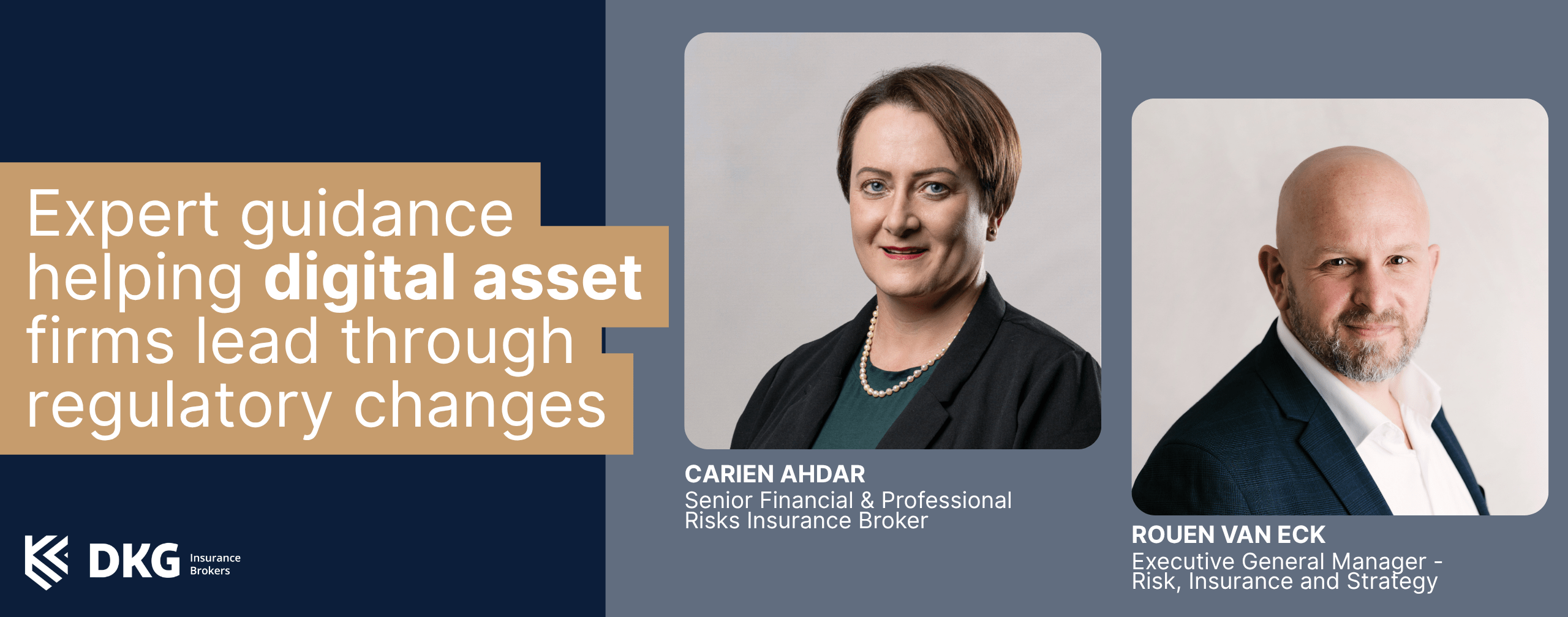
12 November 2025 | By Carien Ahdar and Rouen van Eck
The regulatory landscape just changed and your business needs to be ready.
Australia’s digital asset sector just received the clarity it’s been waiting for, and with it comes a sobering reality. Operating in this space without bespoke liability insurance coverage is about to become both riskier and potentially non-compliant.
On 28 October 2025, the Australian Securities and Investments Commission (ASIC) released updated guidance that fundamentally reshapes how digital asset businesses must operate. The message is clear: if you’re working with stablecoins, wrapped tokens, tokenised securities, digital asset wallets or custody platforms, you are providing a financial product that requires an Australian Financial Services Licence (AFSL).
ASIC’s guidance clarifies how existing laws apply to digital assets, giving investors improved protections and providing firms with greater certainty to operate and innovate. ASIC confirmed its transitional support ahead of proposed law reforms.
Stablecoins (crypto-to-fiat anchor, i.e. USD or AUD), wrapped tokens (crypto-to-crypto bridge), tokenised securities (traditional financial asset like a share, bond or real estate unit that’s been converted into a digital token on a blockchain) and digital asset wallets are among the digital asset products that ASIC considers to be financial products in its updated guidance.
Many widely traded digital assets are financial products under current law and will remain so under the Government’s proposed law reform, meaning many providers require a financial services licence. Licensing ensures consumers receive the full suite of protections under the law and allows ASIC to act when poor practices lead to harm.
What ASIC’s updated guidance means for your business
ASIC’s revised Information Sheet 225 (INFO 225) replaces ambiguous language with concrete classification. ASIC’s guidance on digital assets and related products applies to all firms involved in digital assets, including:
- existing financial services and financial markets businesses, including those exploring the application of blockchain technology to existing financial products and real-world assets (e.g. tokenisation);
- new digital asset businesses;
- brokers and intermediaries; and
- professional advisers to the above businesses.
ASIC has expanded its guidance from 13 to 18 worked examples, covering everything from yield-bearing stablecoins to staking-as-a-service models. This isn’t just regulatory housekeeping. It’s a fundamental shift in how Australian law treats digital assets.
Digital assets and AFSL
ASIC’s role is to administer the law as it currently stands. ASIC INFO Sheet 225: Crypto assets explains how Australia’s financial laws apply to crypto businesses, i.e. when a token might be a financial product or when an AFSL is required. This information sheet includes guidance on ASIC’s interpretation of the application of the Corporations Act 2001 to crypto and digital assets.
A class no-action letter was issued to support the transition to licensing for digital asset businesses to provide transitional class relief for secondary distributors of eligible stablecoins and wrapped tokens.
The no-action position outlines the scope and conditions where ASIC does not intend to take action for breaches relating to the requirement to hold an AFSL, Australian market licence or Australian clearing and settlement (CS) facility licence. It includes an AFSL lodgement window no later than 30 June 2026. The same window applies to Australian market and clearing settlement facility licences. However, rather than a licence lodgement, one of the requirements is that ASIC is notified in writing of a person’s intention to apply.
Using the existing principles-based approach, INFO 225 clarifies that custodial or depository standards apply to any financial product, based on any technology. Relief is proposed allowing businesses to pool digital assets of clients in omnibus accounts.
The no-action position is subject to conditions including the requirement to have Australian Financial Complaints Authority membership and foreign company registration if not Australian-based.
Exclusions to the no-action position
Financial services relating to crypto lending, crypto earning products and crypto derivatives (other than wrapped tokens) are excluded from the no-action position.
The no-action position does not prevent ASIC from taking action where it sees egregious conduct, particularly where there is actual or potential harm to vulnerable consumers or widespread misconduct causing serious consequences such as financial loss, reduced market confidence or fraud. ASIC will also factor in the current no-action position when considering historical conduct but will continue to act against egregious conduct where we see significant consumer harm or widespread systemic misconduct.
ASIC guidance (INFO 225 and CP 381) clarifies that certain tokens, stablecoins or tokenised assets are financial products. Anyone who provides, advises on or deals in financial products needs an AFSL. This means the issuer, exchange or custodian will need an AFSL.
ASIC requires that your business is competent, financially sound, compliant and well-governed when considering your AFSL application. When the AFSL is granted, you must operate according to the licence’s authorisations and obligations.
The primary method of compliance is through maintaining professional indemnity (PI) insurance that is adequate for the nature of the licensee’s business and its potential liability for compensation claims to meet its obligation to maintain arrangements for compensation of clients for any loss or damage arising from a breach (section 912B of the Corporations Act 2001 (Cth)). This obligation is echoed in ASIC Regulatory Guide 126, Compensation and Insurance Arrangements for AFS Licensees.
With INFO 225 instrument, ASIC uses its legal power to fine-tune the rules for the custody obligations under the Act to better fit new or specific business models, while still protecting investors and maintaining regulatory oversight. Relief for certain custody or asset-holding requirements is aimed at making it easier for financial service providers (such as custodians or asset tokenisation platforms) to comply with the law.
For example, the ASIC Custody Amendment Instrument would amend to allow omnibus account structures for digital assets under specified conditions, thus allowing custodian or exchanges to hold many customers’ digital assets together in one big account, instead of giving each person their own separate account on the blockchain.
Commissioner Alan Kirkland framed the update as providing “regulatory clarity that firms have been calling for to innovate confidently in Australia.”
“It is clear that ASIC is drawing a clear line in the sand,” says Carien Ahdar, Senior Financial and Professional Risks Insurance Broker at DKG. “Digital asset businesses that have been operating in a regulatory grey zone, now have certainty about their obligations. The clarity extends to their insurance requirements. Now is the time to secure the right coverage in place before the licencing deadline.”
The guidance confirms that many widely traded digital assets already fall under existing financial product regulations. Products that were operating in a grey zone are now firmly within the regulatory perimeter and providers must hold appropriate licences to continue operations.
The transition window is shorter than you think
ASIC has granted a sector-wide no-action position until 30 June 2026. This leaves businesses only eight months to achieve compliance. While this might seem generous, the reality is more complex. Obtaining an AFSL is not a quick process and assembling the required insurance coverage takes strategic and careful planning with expert guidance. A typical ASIC review takes three to six months but can take longer for complex or crypto-related applications.
Businesses rushing to meet the deadline may find themselves competing for limited underwriting capacity, potentially facing higher premiums or restrictive coverage terms. Early movers who secure appropriate insurance now will be better positioned as the compliance window closes.
Why insurance matters more than ever
Section 912B of the Corporations Act is unambiguous: Australian Financial Securities licensees must maintain arrangements to compensate retail clients for losses arising from breaches of financial services legislation. The Corporations Regulations prescribe that this means holding adequate professional indemnity insurance, unless a specific exemption applies.
For digital asset businesses, the risk profile is uniquely complex. You are navigating:
- Custody and safekeeping risks: Digital assets can be lost through hacking, key management failures or operational errors.
- Cyber security exposures: The digital asset sector remains a prime target for sophisticated cyber attacks.
- Regulatory compliance liability: Failing to meet AFSL obligations can trigger significant legal and financial consequences.
- Directors and Officers’ liability: Board members face personal exposure as they navigate this evolving regulatory framework.
- Professional indemnity: Advice and services provided to clients create potential liability exposures.
The proposed regulatory framework extends further. Treasury’s draft legislation establishes Digital Asset Platforms and Tokenised Custody Platforms as specific types of financial products, with operators facing penalties of up to $16.5 million or 10% of annual turnover for breaches involving misleading conduct or unfair contract terms.
Carien Ahdar emphasises the complexity involved stating, “Designing, negotiating and placing an appropriate liability insurance program for financial services providers is inherently complex. The complexity is compounded for financial service providers in digital asset sector. They face a unique convergence technology, regulatory and financial services risks. Standard professional indemnity and other liability policies don’t provide adequate cover in these circumstances. Off-the-shelf insurance products are rarely fit for purpose.”
DKG has the necessary experience to partner with specialist insurers in emerging digital asset markets to design tailored protection that addresses custody exposures, cyber threats, boardroom risks and the compliance expectations tied to an AFSL. We work with our customers to strengthen their resilience, build regulatory confidence and position themselves for a smoother AFSL approval process.
In this environment, insurance is not a box-ticking exercise. It is fundamental business infrastructure.
The insurance market opportunity
The regulatory clarity ASIC has provided creates a more predictable environment for insurers to offer tailored products for the digital asset sector. The fragmented and uncertain regulatory landscape made it difficult for insurers to apply consistent underwriting standards or properly assess risk.
With defined licensing requirements and compliance obligations now in place, insurers can more confidently structure coverage that reflects the actual risk profile of digital asset operations. This benefits businesses through:
- More comprehensive coverage options designed specifically for digital asset risks.
- Potentially more competitive pricing as insurers gain confidence in the regulatory framework.
- Clearer policy terms that align with AFSL obligations.
- Greater capacity and improved underwriting appetite for digital asset businesses.
Insurers will expect businesses to demonstrate robust risk management, governance frameworks and compliance systems. Generic insurance solutions won’t meet the specialised needs of this sector.
Small platforms aren’t automatically exempt from insurance needs
While the proposed legislation includes exemptions for smaller platforms (those holding less than $5,000 per client and facilitating under $10 million in annual transactions), exemption from licensing does not eliminate business risk.
Cyber incidents, custody failures and operational errors can still occur at any scale. Smart operators recognise that insurance protection makes business sense regardless of whether it’s legally mandated. The cost of being uninsured when something goes wrong far exceeds the investment in appropriate coverage. Cyber security is directly linked to directors’ fiduciary duty to the company, directors facing personal liability for failure of this duty.
What businesses should do now
The eight-month transition period demands immediate action. Here’s what digital asset businesses should prioritise:
- Assess your licensing requirements: Map your operations against ASIC’s 18 worked examples to understand whether you’re providing financial products.
- Audit your current insurance coverage: Most existing policies weren’t designed for digital asset operations and will likely contain exclusions or ambiguous policy wording that leave you exposed.
- Engage specialist insurance brokers: Digital asset insurance requires expertise in both the crypto sector and complex liability insurance markets. Generalist brokers often lack the knowledge to structure appropriate coverage and experience to engage with the specialist markets for appropriate cover.
- Build your compliance framework: Insurers will scrutinise your governance, risk management and operational controls before providing coverage.
- Document your transition plan: ASIC’s no-action position considers firms that are actively working toward compliance more favourably than those ignoring the requirement.
- Budget appropriately: Quality insurance coverage is an investment and rushing to secure policies at the last moment may result in higher costs and or inadequate protection.
Why specialist insurance broking matters
The intersection of digital assets, financial services regulation and complex insurance markets requires specialised knowledge that most businesses don’t have in-house. The wrong insurance structure can leave you exposed to major losses, while over-insuring wastes capital that could be invested in growth.
“We’ve seen businesses approach this with a ‘tick the box’ mentality, only to discover their coverage is inadequate when they need it,” says Rouen van Eck, Executive General Manager, Risk, Insurance and Strategy at DKG. “The AFSL requirement for adequate compensation arrangements isn’t satisfied by just any professional indemnity policy. It needs to be structured specifically for the digital asset environment, considering custody models, wallet infrastructure, smart contract risks and the unique liability profile these businesses face.”
At DKG, our Digital Asset Insurance Broking Advisory service exists precisely for this reason. We understand both the technical aspects of digital asset operations and the intricacies of insurance markets. We work with businesses to:
- Identify the full spectrum of insurable risks in your operations.
- Structure coverage that meets AFSL requirements and protects your business.
- Negotiate with insurers who understand the digital asset sector.
- Ensure policy terms align with the unique characteristics of blockchain-based services.
- Provide ongoing advisory as regulations and your business evolve.
The regulatory environment for digital assets has just become significantly clearer. Businesses that act decisively during this transition period will be positioned for sustainable growth in a properly regulated market. Those that delay may find themselves scrambling for coverage as the deadline approaches or operating without adequate protection in an increasingly regulated and scrutinised sector.
The bottom line
ASIC’s updated guidance is not just about compliance. It is about building a sustainable digital asset sector in Australia where innovation and investor protection coexist. Insurance is central to that framework, providing the safety net that enables businesses to operate with confidence while protecting the clients who trust them with their digital assets.
The June 2026 deadline is approaching faster than most businesses realise. Now is the right time to secure expert insurance advice. Do not leave this until you’re racing to meet the compliance deadline. Negotiating appropriate insurance cover by an experience liability broker involves a measured approach and a rush job will simply not result in the required result.
Ready to ensure your digital asset business has the insurance coverage it needs?
Contact DKG’s Digital Asset Insurance Broking Advisory team today. Let’s discuss how we can help you navigate the new regulatory requirements and secure comprehensive protection for your operations.
Rouen, Carien and the DKG team are ready to help you prepare and mitigate the risk, not just protect. Contact DKG Insurance Brokers today by calling us on 1800 252 926 or email us at insurance@dkg.com.au.